
 English
 Chine
Chine
 Russia
 France
 Spain
Spain
 Arab
Arab
How to Choose the Right Air Compressor for Cement Industry Applications
Choosing an air compressor for cement industry use is less about picking the biggest machine on the floor and more about matching pressure, air quality, dust resilience and lifecycle cost to the way a cement plant actually runs. This guide walks through the compressor types that survive cement environments, the real pressure and flow numbers behind cement industry compressed air requirements, how to size a system without overbuying, and the maintenance habits that keep a cement plant air compressor system online for years.

Why Compressed Air Is the Hidden Backbone of Every Cement Plant
Most people picture a cement plant as a game of heat, stone and rotating kilns. Compressed air is the quiet utility that keeps all of it moving. A compressed air system for cement industry operations touches almost every stage of production, and when it fails, the whole line feels it within minutes.
In raw material preparation, compressed air drives the pneumatic conveying of limestone, clay, fly ash and finished cement through pipelines, replacing messy mechanical elevators in dust-heavy zones. In the clinker and grinding sections, it powers vibration feeders, air slides and aeration pads that keep powdered material flowing instead of clogging. The baghouse — the dust collector that lets a plant stay legal on emissions — depends on timed compressed-air pulse-jet cleaning to keep its filter bags breathing. Instrument air runs the actuators, positioners and analysers in the central control room. And on any given shift, you will find pneumatic tools, tyre inflators and cleaning lances running off the same network.
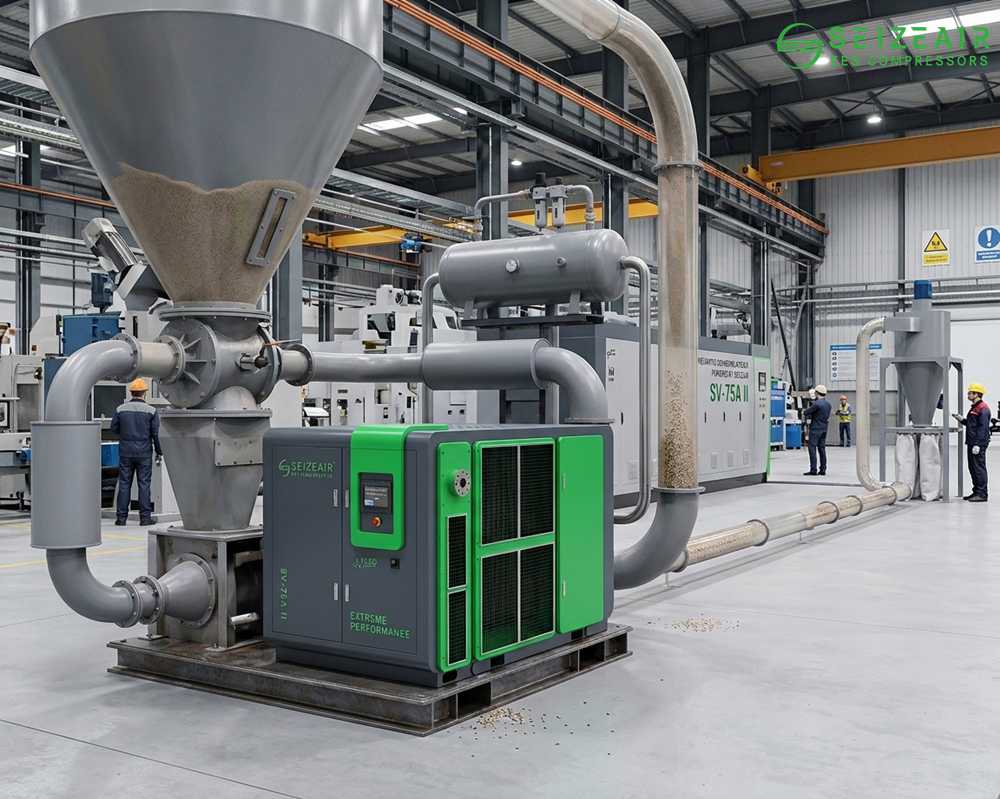
Put simply: a cement plant cannot make, move or clean product reliably without a dependable supply of plant air. That is why the choice of compressor is a strategic decision, not a procurement afterthought.
What Type of Air Compressor Is Used in Cement Plants?
If you tour ten cement plants, you will see the same pattern. The workhorse is almost always a rotary screw machine, because screw compressors deliver a steady, pulsation-free flow that suits continuous 24/7 duty. A rotary screw air compressor for cement plant service is the default for general plant air, instrumentation and baghouse cleaning.
For moving the final powdered product, many plants turn to an oil-free screw blower or an oil-free screw compressor. When you are pushing cement through a pipe, any oil trace in the air stream is a contamination and fouling risk, so oil-free is the safer call for pneumatic conveying. For very large greenfield plants with huge, steady demand, centrifugal compressors earn their place through sheer scale and efficiency at high flow. Reciprocating (piston) units still show up, but mostly for small, intermittent duties, spare capacity or workshop air rather than the main plant network.
The practical answer for most existing plants is a skid of oil-injected rotary screw compressors for plant and instrument air, paired with oil-free machines or blowers for product contact. Among screw designs, a permanent magnet two-stage screw air compressor has become the favourite for plants chasing lower power bills, because two-stage compression and a permanent-magnet variable-speed drive squeeze more air out of each kilowatt.
How Much Air Pressure and Volume Does a Cement Plant Need?
There is no single number, but there is a useful range. General plant and instrument air usually sits around 6 to 8 bar (roughly 87 to 116 psi). Baghouse pulse-jet cleaning often wants a cleaner, drier supply in the same band but with tighter air-quality specs. Pneumatic conveying is the outlier: depending on pipe length, lift and material, it can demand anywhere from around 1 bar for gentle air-slide aeration up to 3 or 4 bar for dilute-phase blowing, while some dense-phase systems run higher.
The trap most buyers fall into is sizing only for nameplate flow. Real plants leak. A network that is a few years old routinely loses 10 to 30 percent of its air through worn couplings, badly seated drains and undocumented taps. Your cement industry compressed air requirements on paper and the air you actually deliver at the point of use are two different things.
A snapshot of where the air goes and what it needs:
| Application in the plant | Typical pressure | Air-quality priority | Common compressor choice |
|---|---|---|---|
| Baghouse pulse-jet filter cleaning | 6–7 bar | Dry, oil-free preferred | Oil-free screw or treated plant air |
| Pneumatic conveying of cement / raw meal | 1–4 bar | Oil-free essential | Oil-free screw blower / compressor |
| Process instrumentation & control valves | 6–7 bar | Very dry, clean | Dryer + filter on plant air |
| Air slides & aeration pads | 0.5–1 bar | Low dew point | Low-pressure blower |
| Pneumatic tools & workshop | 6–8 bar | Basic filtration | Plant air tap-off |
Air quality matters here more than people expect. If you want the formal class limits for particles, water and oil in plant air, our breakdown of compressed air quality standards is worth a read before you spec your dryers and filters.
How to Calculate Air Compressor Capacity for a Cement Plant
Sizing is where good and bad purchases are decided. You are not guessing a number; you are building one from the actual consumers on site. Start by listing every air-using device, its rated free-air delivery (FAD) in cubic feet per minute or cubic metres per minute, and how often it actually runs.
The plain-text logic looks like this:
Total demand = ( Sum of each tool’s flow multiplied by its usage factor ) divided by compressor package efficiency, then add a leakage allowance of 10 to 15 percent, then add a future-growth margin of 15 to 20 percent.
In shorter form:
Q_required = ( SUM over i of Q_i times K_i ) divided by eta_pack plus Q_leak plus Q_growth
Where Q_i is the flow of device i, K_i is how much of the time it runs (0.2 to 1.0), eta_pack is the practical efficiency of the package, Q_leak is 10 to 15 percent of the subtotal, and Q_growth is your 15 to 20 percent buffer for new lines or bags. A proper air compressor capacity calculation cement plant exercise also separates steady base load from intermittent peaks, because base load should be carried by your most efficient VSD machine while peaks are covered by trim units.
If your demand swings through the day — common when conveying and bagging batch rather than run continuously — a two-stage compression package with variable speed will track the load and avoid the waste of running a fixed-speed machine unloaded for hours.
Oil-Free vs Oil-Injected: Which Air Compressor Suits Cement Production?
This is the question plant engineers argue about, and the honest answer is “both, in different places.” Oil-injected rotary screw compressors are rugged, cheaper per cubic metre and perfectly fine for general plant air, workshop and most instrument duties once you add a dryer and coalescing filter. They are the sensible backbone of a compressed air system for cement industry use.
But the moment compressed air touches the product — pneumatic conveying of cement, air slides, anything near the finished silo — an oil free air compressor for cement industry duty is the responsible choice. Oil carryover into powder is a quality and cleaning headache you do not want. Oil-free screw technology, including the permanent magnet single-stage screw air compressor class for moderate flows, keeps the air class zero on oil content without relying on downstream filtering to catch every droplet.
The trade-off is upfront cost and a slightly fussier airend, which is why most plants run oil-injected for the bulk and oil-free for product contact rather than paying to make everything oil-free.
Key Features to Look for in an Air Compressor for Cement Industry
Cement plants are hostile to machinery. High and swinging ambient temperatures, choking dust, and round-the-clock load mean a generic workshop compressor will struggle. When you shortlist a best air compressor for cement manufacturing candidate, weigh these features:
- Dust resilience. Oversized, easily serviced intake filters and closed-loop cooling that does not breathe plant air. Pre-filter boxes pay for themselves.
- High ambient rating. Look for a package rated to at least 45 to 50 degrees Celsius, not the standard 40, because compressor rooms in summer get hot.
- Variable speed drive. A variable speed air compressor for cement industry duty trims energy on partial load, which is where most plants actually live.
- Two-stage compression. Better specific power, cooler discharge, longer airend life.
- Remote monitoring. Pressure, temperature, load hours and fault codes piped to the control room so you fix small issues before they become stoppages.
- Serviceability. Can your local technician reach the airend, separator and bearings without a crane?
For plants that want efficiency without the complexity of oil-free product contact, a high efficiency two-stage screw air compressor with a permanent-magnet drive is the sweet spot: lower power draw, steadier output, and a footprint that drops into most existing compressor houses.
A Quick Comparison of Compressor Options for Cement Plants
Different technologies fit different jobs. Here is how they stack up for cement service:
| Technology | Best fit in cement | Pressure / flow | Watch out for |
|---|---|---|---|
| Oil-injected rotary screw | Plant air, instruments, tools | Up to ~13 bar, wide flow | Oil carryover if used on product |
| Oil-free screw / blower | Conveying, aeration, product contact | Low to mid pressure, large flow | Higher capital cost |
| Centrifugal | Large steady base load | High flow, steady pressure | Poor on swinging load, surge risk |
| Reciprocating | Small, intermittent, workshop | High pressure, low flow | Vibration, pulsation, maintenance |
How to Size and Select the Right Air Compressor for Cement Manufacturing
Selection is a process, not a price comparison. Walk it in order:
- Map the demand. List every consumer, its flow and duty cycle. This is your capacity calculation from earlier.
- Split base load from peak. Let an efficient VSD carry the base; let trim units handle peaks.
- Separate product air from plant air. Decide where oil-free is mandatory and where oil-injected is fine.
- Choose pressure class. Do not over-pressure. Every extra bar costs roughly 7 percent more energy for the life of the machine.
- Plan the air treatment. Dryers, filters and drains sized to the dirtiest, hottest, most humid day you actually get.
- Check the room. Ventilation, intake location away from dust, and space to service the airend.
- Get the lifecycle number. Compare specific power (kWh per cubic metre) and total cost of ownership, not just sticker price.
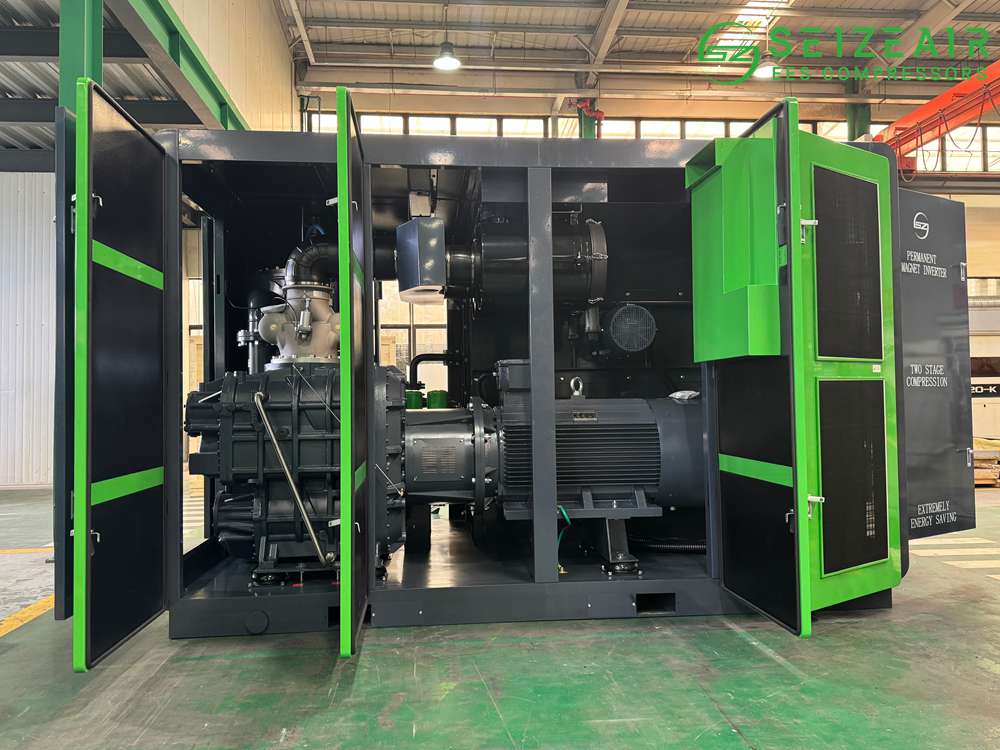
A high pressure air compressor for cement plant duties — think instrument air boosted for special valves or higher-pressure conveying — should be sized as a dedicated small system rather than forcing the whole network up to an uneconomic pressure.
Energy Consumption and Operating Cost of Air Compressors in Cement Plants
Here is the number that should keep a plant manager awake: the compressor is rarely the biggest capital item, but it is almost always the biggest electricity user in the utility room. Over a ten-year life, the power bill dwarfs the purchase price several times over.
The cost math is straightforward:
Annual electricity cost = motor power in kilowatts, multiplied by running hours per year, multiplied by your electricity tariff per kilowatt-hour.
So a 250 kW compressor running 8,000 hours a year at 0.10 per kWh burns about 200,000 in power alone. Shave 15 percent off that with efficient two-stage compression and variable speed, and you are looking at 30,000 a year back in the bank. That is why a variable speed air compressor for cement industry investment is usually paid back in well under two years on a busy line, and why chasing the cheapest machine is often the most expensive mistake.
Maintenance Checklist: Keeping Your Cement Plant Air Compressor Running
Cement dust finds every gap. A disciplined air compressor maintenance in cement plant routine is what separates a machine that lasts fifteen years from one that fails in three. A simple, realistic schedule:
| Task | Frequency | Why it matters in cement |
|---|---|---|
| Inspect and replace intake pre-filters | Weekly (dusty sites: more often) | Dust chokes airflow and loads the airend |
| Check separator and drain function | Weekly | Stops water and sludge reaching the network |
| Review operating temperature and pressure trends | Daily via monitoring | Catches overheating before failure |
| Service airend, oil and filters | Per manufacturer hours | Protects the most expensive component |
| Leak audit of the whole network | Quarterly | Recovers 10 to 30 percent of lost air |
For a fuller, copy-paste routine you can hand to your technicians, our air compressor maintenance checklist lays out the daily, weekly and monthly tasks in one place.
Common Air Compressor Problems in Cement Plants and How to Avoid Them
Most cement-plant compressor failures are boring and predictable, which means they are avoidable:
- Dust ingestion. Fix it with proper pre-filtration and intake routing, not by replacing airends.
- Overheating. Usually poor ventilation or blocked coolers. Size the room and clean the coolers on a schedule.
- Oil carryover onto product. Solved by isolating product air to oil-free machines or blowers.
- Undetected leaks. A quarterly ultrasonic leak survey pays for itself fast.
- Unloaded running. Fixed-speed machines left blowing off at night waste serious energy; variable speed or proper sequencing stops it.
Why Seize Air Builds Compressors That Survive Cement Plant Conditions
Seize Air has spent years tuning its screw platforms for exactly the abuse a cement plant dishes out — high ambient heat, heavy dust, and the kind of continuous load that punishes any weak link. The permanent-magnet two-stage and oil-free screw blower lines were developed with cement and similar powder-handling plants in mind, with closed-loop cooling, oversized filtration and the monitoring a control room needs. For plants weighing a best air compressor for cement manufacturing decision, that application focus is the difference between a compressor that merely runs and one that stays efficient for a decade.
A Real-World Note: What a Cement Plant Upgrade Looks Like
When a mid-size plant swaps a pair of aging fixed-speed units for a permanent-magnet two-stage VSD skid plus a dedicated oil-free blower for conveying, the pattern is consistent: steadier pressure at the bags, fewer unloaded hours, and a measured double-digit drop in compressed-air power. Seize Air has delivered this shape of upgrade to powder and cement-adjacent plants where downtime is measured in lost tonnes, not lost minutes. The point is not the brand badge — it is designing the system around the plant’s real load instead of a catalogue number.
How to Choose the Right Air Compressor for Cement Industry Applications — Final Scorecard
Before you sign, run your shortlist against this scorecard:
| Factor | What to confirm | Red flag |
|---|---|---|
| Capacity | Matches calculated demand plus growth | Sized only on a guess |
| Air quality | Oil-free isolated to product contact | One oily network for everything |
| Efficiency | Low specific power, VSD + two-stage | Fixed-speed only, no data |
| Durability | Rated for high ambient and dust | Standard 40 C rating |
| Service | Local support, reachable airend | No local parts or technician |
| Lifecycle cost | TCO modelled over 10 years | Compared on price alone |
Get a Custom Compressed Air Solution for Your Cement Plant
Every cement plant is laid out differently, runs a different load curve, and fights a different dust and heat profile. The fastest way to stop guessing is to have your demand, air quality and room conditions reviewed by people who build compressors for this industry. If you are specifying or replacing an air compressor for cement industry duty, reach out to the Seize Air team with your plant details — flow, pressure, duty hours and the applications you need to cover — and we will put together a sized, efficient proposal rather than a one-size box. Contact us to start the conversation and get a compressed-air system that actually fits how your plant runs.
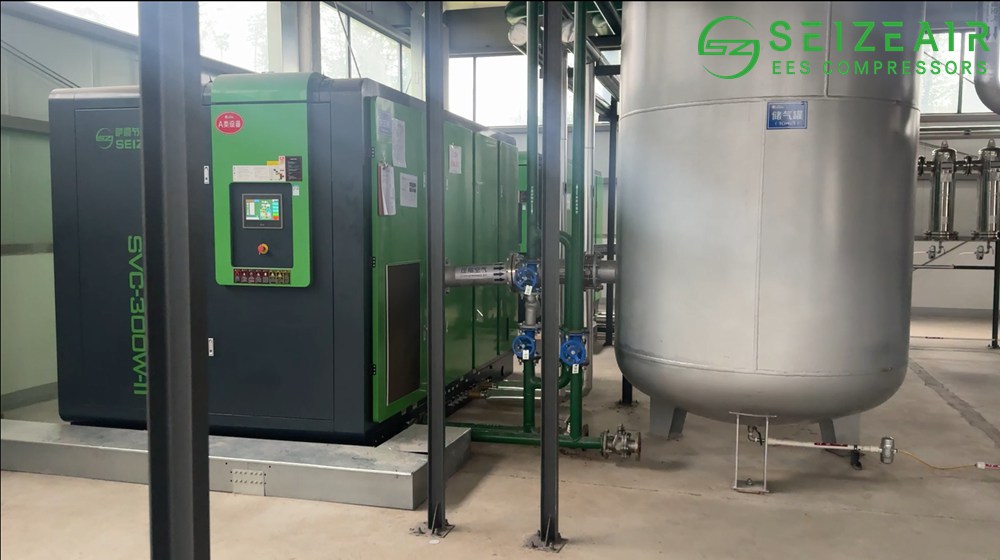
Conclusion
The right air compressor for cement industry applications is the one matched to your real pressure, flow, air-quality and dust conditions — not the biggest or cheapest unit on the quote. Get the type, sizing and oil-free split right, protect it with a simple maintenance routine, and the compressed-air system becomes a quiet asset that keeps the whole plant moving for years.